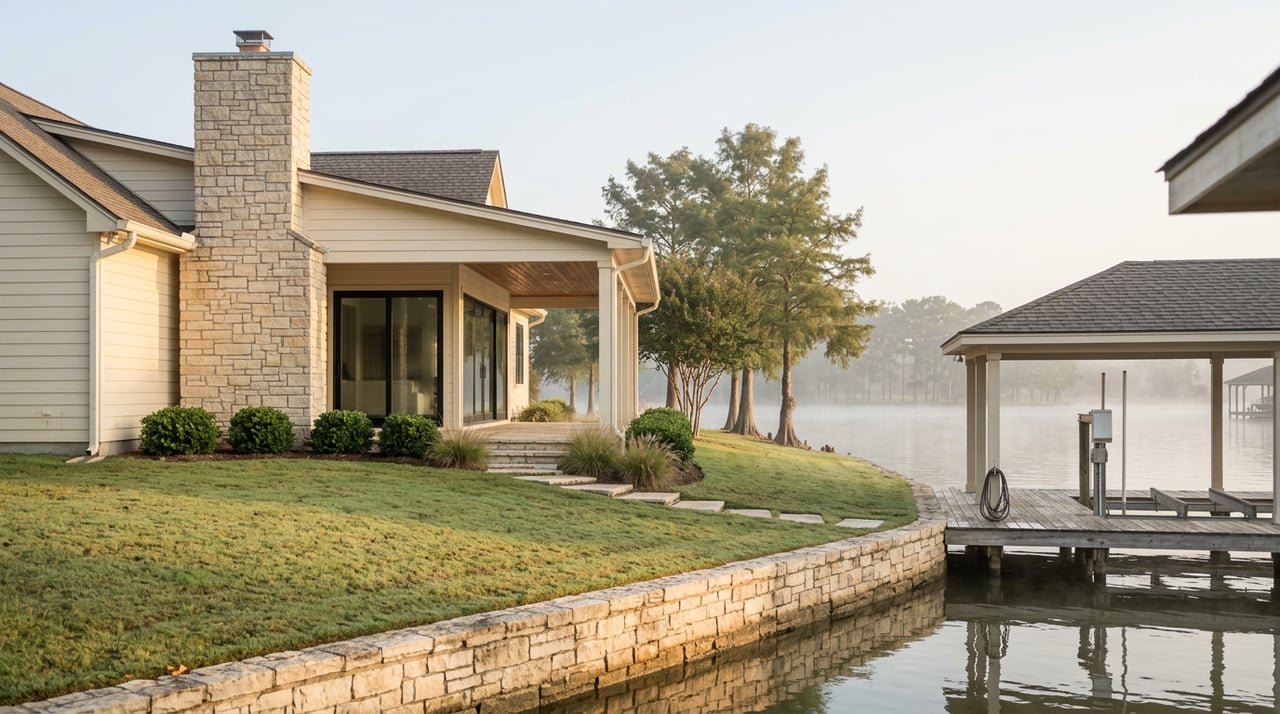
A buyer walks the dock during a Saturday showing. It's solid, recently stained, wired for a boat lift. In the buyer's mind, it's already part of the deal, the same way the refrigerator or the ceiling fans are part of the deal. Nobody stops to ask who actually owns the ground under that dock, because on a normal residential lot, the answer is obvious. On Cedar Creek Lake, it isn't.
That gap between what a buyer assumes and what a closing actually conveys is where most of the friction in a Gun Barrel City lakefront purchase lives. It rarely shows up in the listing description, and it rarely comes up until an inspection period is already ticking.
Who Actually Controls the Water's Edge
Cedar Creek Reservoir was built in 1965 as a water supply project, originally to serve Fort Worth and other North Texas communities. It stretches roughly 18 miles long and just over 2 miles wide, with more than 220 miles of shoreline and a maximum depth of 62 feet. The lake also holds three islands that Texas Parks and Wildlife manages as wildlife areas for aquatic birds.
The entity that built the reservoir still owns the lakebed beneath it. The Tarrant Regional Water District, or TRWD, controls the lake up to its conservation elevation of 322.00 feet above mean sea level. That single number matters more than most buyers realize. Anything a homeowner builds into the water, a dock, a boathouse, a bulkhead, sits on land TRWD owns, not land the homeowner owns, even when the home itself sits on a private, deeded lot right up to the shoreline.
TRWD also maintains a flood easement between elevation 322.00 and 325.00 feet, the current 100-year flood level. That strip of shoreline can flood, by design, and the district holds an easement over it specifically because it expects to use that space to hold water temporarily during high-rainfall periods. A dock or retaining wall built in that zone was built inside a working flood buffer, not a permanent yard extension.
The Permit Question Nobody Asks at the Showing
Because TRWD owns the ground under the water, any structure extending into the reservoir needs an improvement permit from the district, not just a local building permit. The application requires proof of ownership, construction plans and materials, and a $100 non-refundable fee. TRWD asks for roughly 10 working days to process a completed application, and once issued, a construction permit is valid for a minimum of 30 days and a maximum of 90.
None of that is the part that catches buyers off guard. The part that catches buyers off guard is that a permit is tied to the structure and the district's approval, not automatically to a change in homeowner. A seller who built a dock in 2015 may have a valid permit sitting in a file drawer, or may have built it without one, or may have modified it since without telling anyone. A buyer who assumes the dock simply comes with the house is assuming a transfer that hasn't necessarily happened.
This is the single most useful question a Gun Barrel City buyer can ask before writing an offer: does the seller have a copy of the TRWD improvement permit for every structure extending into the water, and has the district confirmed it's current for this specific dock or boathouse. If the answer is unclear, that's a due diligence item, not a formality, because an unpermitted structure can become the buyer's problem the day after closing.
HOA or POA rules layer on top of this. Some lakefront subdivisions restrict dock size, materials, or even rental use through their own covenants, separate from anything TRWD requires. A buyer verifying permit status should ask the same questions of the property's association, if one exists.
Why the Septic System Is the Real Line Item
The second layer almost nobody budgets for at the offer stage is wastewater. Most Cedar Creek Lake properties, including homes throughout Gun Barrel City, rely on septic systems rather than centralized sewer. In Texas, these are called on-site sewage facilities, or OSSFs, and they fall under Texas Commission on Environmental Quality rules, with day-to-day permitting handled locally. For Gun Barrel City and the surrounding lake area, that local authority is Henderson County.
Which type of system a given lot can legally use isn't a matter of preference. It depends on the soil. Areas with adequate topsoil support conventional gravity systems. Areas with thin soil or heavy clay, common on lakefront lots where rock sits close to the surface, are typically required to use an aerobic treatment system instead.
That distinction changes the cost profile of the home significantly:
| Conventional System | Aerobic System | |
|---|---|---|
| Typical install cost | $10,000 to $15,000 | $15,000 to $20,000 |
| Ongoing maintenance | Pump every 3 to 5 years | Mandatory annual maintenance contract |
| Inspection frequency | As needed | Required 3 times per year |
| Legal requirement | Standard permit | Maintenance contract required by state law |
Aerobic systems are the more likely reality on a lakefront lot, and they come with an obligation that has nothing to do with the buyer's preferences. Under Texas Health and Safety Code Section 366.0515, every aerobic system owner must maintain an active service contract with a licensed maintenance provider, with inspections roughly every four months. It isn't optional, and it isn't a one-time cost. A typical maintenance contract runs in the range of a few hundred dollars a year, and letting that contract lapse can bring citations from the county and, in repeated cases, a requirement to replace the system entirely.
For a buyer, this means the septic system on a Cedar Creek Lake home isn't a pass-fail inspection item the way it might be inland. It's an ongoing line item that should factor into the offer the same way property taxes or HOA dues do, and it's worth knowing before the option period closes whether the current maintenance contract is active and transferable.
Before You Write, or Accept, an Offer
For a buyer moving toward an offer on Gun Barrel City lakefront property, a few verifications are worth doing early, before they become a scramble during the option period:
- Ask the seller for the TRWD improvement permit covering any dock, boathouse, or bulkhead, and confirm with the district that it's current and matches the structure as built.
- Confirm whether the property sits within the 322 to 325 foot flood easement zone, since that affects what future modifications the district will approve.
- Identify whether the septic system is conventional or aerobic, and if aerobic, request proof of an active maintenance contract and recent inspection reports.
- Check with Henderson County on the system's permit history, especially if any repairs or alterations have happened since the original install.
- Review HOA or POA covenants for any additional dock, rental, or exterior modification restrictions specific to the subdivision.
- Check current lake levels through TRWD's public reporting before a showing, since water levels affect dock accessibility and can shift a buyer's read on a property between visits.
For sellers, the same list works as a pre-listing checklist. A file with a current TRWD permit, recent septic maintenance records, and clean HOA standing removes exactly the kind of uncertainty that gives a buyer's agent leverage to renegotiate mid-contract.
A Few Quick Answers
Does a dock permit automatically transfer when a home sells? Not automatically. The permit is tied to TRWD's approval of the specific structure. A buyer should confirm directly with the district that an existing dock's permit is current and applies to the structure as it exists today.
Do all Gun Barrel City lake homes require a septic system? Most lakefront properties do, since municipal sewer isn't universal around the lake. Whether a given lot uses a conventional or aerobic system depends on the soil conditions the county's site evaluation identifies.
Where do I check current lake levels before a showing? TRWD publishes daily lake level reports and a public lake level blog, which is worth checking before evaluating dock height, shoreline exposure, or boat access at a specific property.
Cedar Creek Lake rewards buyers who ask about the parts of the property that a standard walkthrough doesn't reveal. If you're weighing a lakefront purchase in Gun Barrel City, or getting a waterfront home ready to list, The Cole Home Team can help you sort through the permit history, the septic status, and everything else that determines what you're actually buying. Request a Free Home Valuation and let's talk through what your specific property needs before it ever hits the market.