When you sit down to compare mortgage offers, the interest rate is usually the first number you see. It’s also the least complete number on the page.
In a market where the 30-year fixed-rate average hovers around 7.5%, the difference between a 7.25% rate and a 7.5% rate can look significant. But that comparison only tells part of the story. The Annual Percentage Rate, or APR, tells the rest. We see buyers get caught off guard by this all the time: they zero in on a shiny teaser rate, only to realize at the closing table that thousands of dollars in extra lender fees ate up whatever savings they thought they had locked in.
A thorough mortgage rate comparison requires understanding what APR includes, why lenders are required to disclose it, and how local North Texas factors can shift the real cost of borrowing well beyond what an advertised rate suggests.
What APR Actually Measures
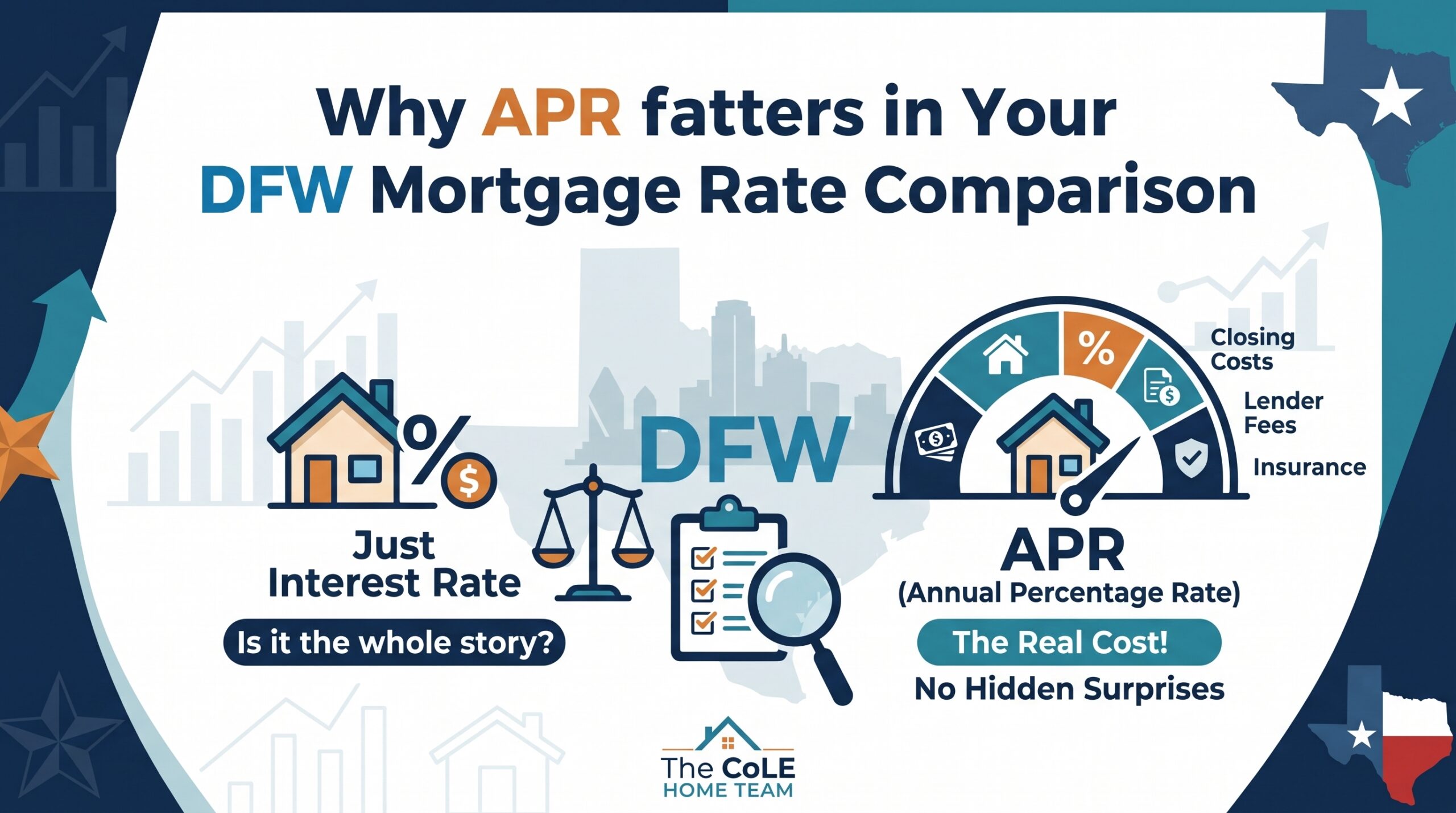
The interest rate on a mortgage reflects the cost of borrowing the principal balance. APR goes further. It folds in most loan-related fees and expresses the total yearly cost of the loan as a single percentage.
Simply put, APR captures the interest rate, discount points, broker fees, and other lender charges in one standardized figure.
That standardization is the point. Two lenders can quote you the exact same interest rate while charging drastically different fees. APR exposes that gap. A loan with a 7.25% rate and $8,000 in origination fees often carries a higher APR than a loan with a 7.4% rate and minimal upfront charges. Looking at the interest rate alone would point you straight toward the more expensive offer.
Key takeaway: When comparing two mortgage offers, always place the APR side by side, not just the interest rate. A lower rate with high fees frequently costs more over the life of the loan than a slightly higher rate paired with low closing charges.
Federal Law Requires APR Disclosure—Use It to Your Advantage
Lenders do not disclose APR as a courtesy. They are legally required to do so under the Truth in Lending Act (TILA). Enacted to protect consumers, TILA mandates that lenders clearly disclose the APR, total finance charges, and payment schedule before you commit to a mortgage.
This requirement gives borrowers a consistent, apples-to-apples basis for evaluating loan offers across different lenders.
In practice, this means the Loan Estimate you receive within three business days of applying is a standardized legal document. Page three of that form clearly displays the APR and the total interest paid over the loan term. Pull that exact page from every lender you approach and line them up. That side-by-side review is your true mortgage rate comparison.
What Gets Included in APR (and What Doesn’t)
Understanding each component helps you read your Loan Estimate with confidence.
APR typically includes:
The base interest rate
Origination fees and lender points
Mortgage broker fees
Prepaid interest (discount points paid to buy down the rate)
Private mortgage insurance (PMI) premiums, when applicable
APR generally does not include:
Title insurance and closing agent/escrow fees
Home appraisal fees
Home inspection costs
Prepaid property taxes or homeowners insurance escrow
Those excluded costs still impact what you bring to the closing table. In Texas, total closing costs typically run between 2% and 5% of the loan amount. On a $385,000 home in Forney, that range translates to roughly $7,700 to $19,250 in closing expenses, depending on the loan structure and lender. Knowing which costs live inside the APR versus outside it gives you an unvarnished view of the true cash required.
North Texas Factors That Complicate a Simple Rate Comparison
Generic national mortgage advice treats every market the same. North Texas does not work that way, particularly in the fast-growing communities east of Dallas.
Property Taxes in Kaufman and Rockwall Counties Property taxes across our area are never an afterthought. Kaufman County carries an effective property tax rate of around 1.9%, while Rockwall County sits closer to 2.1%.
On a $520,000 home in Rockwall, a 2.1% effective tax rate adds roughly $10,920 every year to your cost of ownership. That annual expense heavily dictates your debt-to-income ratio, your monthly escrow payment, and your everyday comfort level with the home. While property taxes do not appear in the APR calculation, they must be part of any honest affordability comparison.
MUD and PID Districts in New Construction Many new construction communities in Forney, Fate, Royse City, and across Kaufman and Rockwall counties sit inside Municipal Utility District (MUD) or Public Improvement District (PID) boundaries. These districts levy additional assessments on top of standard county and city taxes, occasionally adding 0.5% to 1.5% or more to the effective annual tax burden.
A builder may advertise an aggressive interest rate buydown, but if the house sits inside a MUD with an extra 1.2% assessment, your monthly payment savings can vanish overnight. Make sure you factor local district assessments into your payment projections before falling in love with an incentive package.
Builder Rate Buydowns and Incentive Math Roughly 65% of new construction developments in North Texas offer builder incentives, with rate buydowns leading the pack. A builder’s preferred lender might advertise a 5.99% rate when market averages sit higher—an offer that sounds irresistible on a flyer.
The key question to ask is whether that buydown is temporary or permanent:
A 2-1 buydown lowers your rate for the first two years before stepping back up to the standard note rate.
A permanent buydown is purchased upfront with discount points, which gets baked directly into the APR.
Comparing the APR on a builder-incentive package against a conventional offer from an independent lender is the only way to confirm whether that builder promotion is a genuine financial break or merely restructured closing fees.
How to Run a Proper Mortgage Rate Comparison
Following a clean, repeatable checklist keeps lenders honest and the math clear:
Apply with at least three lenders within a tight window. Credit bureaus treat multiple mortgage inquiries within a 14- to 45-day window as a single credit inquiry, protecting your score.
Request Loan Estimates for identical loan scenarios. Match the purchase price, down payment percentage, and loan type (e.g., comparing a 30-year conventional to a 30-year conventional).
Compare APRs on Page 3. This is your primary baseline for total financing costs.
Examine the fee breakdown on Page 2. Two loans with similar APRs may handle costs differently; one might roll fees into the interest rate, while another demands higher upfront cash.
Add local property taxes and MUD/PID assessments. Layer local tax rates on top of each loan scenario to see your true monthly cash outflow.
Confirm rate locks in writing. Verify whether each estimate includes a rate lock and how long that lock lasts prior to closing.
When a Lower APR Isn’t the Whole Answer
APR formulas assume you will hold the mortgage for the entire 30-year term. In reality, most Texas homeowners move or refinance within seven to ten years. Because of that, a loan with lower upfront closing costs and a slightly higher interest rate can easily cost less overall than a discounted rate stacked with hefty upfront points.
Calculate your break-even point: divide the upfront cost of any rate-buydown points by the monthly payment savings they create. If it takes six years to break even on those points and you plan to relocate or upsize in five, paying extra upfront for the lower rate loses you money.
Small APR Differences Mean Real Money
On a $385,000 purchase in Forney with 10% down, you are financing $346,500. A modest difference of just 0.25% in APR amounts to roughly $17,000 in additional interest over a 30-year term.
On a $520,000 purchase in Rockwall with 20% down ($416,000 loan balance), that same 0.25% APR spread creates a gap of more than $20,000. That is cash right out of your pocket—and why spending an afternoon comparing Loan Estimates is just as important as negotiating the sale price.
The Bottom Line Before You Write an Offer
A proper mortgage rate comparison is not a single checkbox—it runs hand-in-hand with your neighborhood search.
The buyers who win in today’s market look past shiny headline rates. APR exposes the true lender fees, the Loan Estimate brings clarity to the fine print, and local Kaufman and Rockwall county tax structures reveal what you actually pay each month.
Robert, Mandy, and Cameron Cole work alongside home buyers across Kaufman County, Rockwall County, Forney, Terrell, and the entire DFW metroplex. While we leave the lending regulations to the mortgage pros, we know the local developments, tax structures, and purchase contracts inside and out. If you are weighing loan options on a specific property and want an honest look at how the real numbers stack up, reach out to The Cole Home Team today.
Sources Referenced
- What is APR? Understanding Your Annual Percentage Rate (www.capcenter.com)
- What Is The Truth In Lending Act (TILA)? (www.rocketmortgage.com)
Frequently Asked Questions
What is the difference between a mortgage interest rate and APR?
The interest rate only reflects the cost of borrowing the principal balance. APR goes further by folding in most loan-related fees, such as origination fees and lender points, and expresses the total yearly cost of the loan as a single percentage.
Why is APR important when comparing mortgage offers?
APR is important because it provides a standardized figure that includes both the interest rate and most lender fees. This allows for a more accurate apples-to-apples comparison between different loan offers, preventing buyers from being misled by a low advertised interest rate that hides significant upfront charges.
What costs are typically included in the APR calculation?
APR typically includes the base interest rate, origination fees, lender points, mortgage broker fees, prepaid interest, and private mortgage insurance premiums. These are all costs directly associated with obtaining the loan itself.
What costs are generally NOT included in the APR calculation?
Costs such as title insurance, closing agent fees, appraisal fees, home inspection costs, and prepaid property taxes or homeowners insurance are generally not included in the APR. While these costs impact your total cash needed at closing, they are separate from the loan's finance charges.
How do local North Texas property taxes affect mortgage affordability beyond APR?
Local property taxes, especially in counties like Kaufman and Rockwall, significantly increase your annual cost of ownership and monthly payments. While not included in APR, these taxes heavily influence your debt-to-income ratio and overall affordability, making them crucial for a complete financial comparison.