Table of Contents
- Why Are Homebuilders Offering Incentives in 2026?
- What Are Builder Incentives?
- Temporary Mortgage Rate Buydowns: Lower Payments Today
- Permanent Mortgage Rate Buydowns: Lower Interest Over Time
- Purchase-Price Reductions: Paying Less for the Home
- Rate Buydowns vs. Price Cuts: A $400,000 North Texas Home Example
- Why Might Builders Prefer Mortgage Rate Buydowns?
- North Texas Buyers: Don't Forget Property Taxes, MUDs, PIDs, and HOA Fees
- Should You Use the Builder's Preferred Mortgage Lender?
- Five Questions to Ask Before Accepting a Builder Incentive
- Why Having Your Own REALTOR® Matters With New Construction
- Frequently Asked Questions About North Texas Builder Incentives
- Before You Accept a Builder Incentive, Know What You're Really Getting
North Texas Builder Incentives: Rate Buydowns vs. Price Cuts
Updated November 2026 | By The Cole Home Team | North Texas Real Estate
Thinking about buying a new construction home in North Texas? Before accepting a builder’s advertised mortgage rate or price reduction, make sure you understand which incentive could actually save you more money.
Across Forney, Rockwall, Royse City, Terrell, McKinney, Prosper, and the greater Dallas–Fort Worth area, new construction buyers may encounter offers involving mortgage rate buydowns, closing-cost assistance, upgrades, and purchase-price reductions.
But here’s the question every buyer should ask:
Is the builder offering the best deal for you—or simply the incentive that works best for the builder?
The answer isn’t always obvious.
A lower mortgage rate can reduce your monthly payment. A price reduction can lower your purchase price and mortgage balance. Both can be valuable, but they work differently.
At The Cole Home Team, we believe buying a home should start with understanding the numbers—not getting distracted by the biggest advertised incentive.
Let’s break down what North Texas homebuyers need to know.
Why Are Homebuilders Offering Incentives in 2026?
The national new construction market has been experiencing affordability pressures, and builders are using incentives to attract qualified buyers.
According to the National Association of Home Builders’ October 2026 report:
65% of surveyed builders reported using sales incentives.
43% reported reducing home prices.
The average price reduction among builders cutting prices was 6%.
These are national survey figures, not statistics specific to Forney, Rockwall, or the Dallas–Fort Worth market.
Nevertheless, they demonstrate why buyers should investigate available incentives rather than assume the advertised purchase price tells the whole story.
Incentives can vary by builder, subdivision, inventory level, financing program, and closing date.
A completed inventory home may carry a different offer than a home that has not yet been built.
The takeaway: Don’t assume two homes with similar advertised prices have the same total cost of ownership.
What Are Builder Incentives?
Builder incentives are financial benefits or concessions a homebuilder may offer to encourage a buyer to purchase a new construction property.
Common examples include:
Temporary mortgage rate buydowns: Reduced mortgage payments during an introductory period.
Permanent mortgage rate buydowns: An upfront contribution toward obtaining a lower fixed interest rate.
Purchase-price reductions: A lower agreed-upon price for the property.
Closing-cost assistance: Credits toward eligible settlement and financing expenses.
Design or upgrade allowances: Credits toward selected finishes, appliances, or upgrades.
Move-in-ready home promotions: Incentives on qualifying completed or nearly completed homes.
Not every incentive is available on every property, and some offers require buyers to use a particular lender or meet specific financing conditions.
The important question isn’t simply how much the builder advertises.
It’s how much the incentive actually benefits you financially.
Temporary Mortgage Rate Buydowns: Lower Payments Today
A temporary mortgage rate buydown reduces the buyer’s effective mortgage payment during an initial period, commonly one to three years.
One familiar example is a 2-1 buydown.
Suppose you obtain a 30-year fixed-rate mortgage with a 7.25% note rate.
A hypothetical 2-1 buydown could provide:
Year 1: Payments calculated using 5.25%.
Year 2: Payments calculated using 6.25%.
Year 3 onward: Payments calculated using the full 7.25% note rate.
The mortgage’s contractual interest rate remains 7.25%. The temporary payment difference is generally covered through a funded subsidy arrangement.
This distinction matters because the reduced payment does not continue indefinitely.
A temporary buydown may help a buyer manage early homeownership expenses, but buyers should be prepared for the full payment after the subsidy expires.
Loan qualification generally relies on applicable underwriting requirements rather than assuming the introductory payment will continue.
Our advice: Before accepting a temporary buydown, ask your lender to show your full monthly payment for every year of the program, including taxes and insurance.
Permanent Mortgage Rate Buydowns: Lower Interest Over Time
A permanent rate buydown generally involves paying discount points or other applicable upfront financing costs to obtain a lower interest rate.
Unlike a temporary buydown, the lower fixed rate can continue for the life of the mortgage, assuming the loan is not refinanced or paid off.
The Consumer Financial Protection Bureau explains how discount points work.
A discount point typically equals 1% of the loan amount, but the amount of interest-rate reduction purchased by a point varies by lender and market conditions.
For example, one point on a $320,000 mortgage equals $3,200.
That does not mean paying $3,200 automatically reduces your rate by any particular percentage.
Buyers should request written comparisons showing the available interest rates, upfront costs, and estimated savings over their expected ownership period.
A permanent buydown can be attractive for buyers planning to keep their mortgage for many years, but the upfront cost and break-even period matter.
Purchase-Price Reductions: Paying Less for the Home
A purchase-price reduction works differently.
Instead of subsidizing financing, the builder agrees to sell the home for a lower price.
For example:
Original purchase price: $400,000
Negotiated price reduction: $15,000
New purchase price: $385,000
With a 20% down payment, the buyer’s initial loan amount decreases from $320,000 to $308,000.
This can reduce monthly principal-and-interest payments, the initial mortgage balance, and the down payment required at the same percentage.
However, a lower purchase price does not automatically result in a lower Texas property tax assessment. Local appraisal districts determine taxable values under Texas law.
A price reduction also may not create the same immediate monthly savings as a subsidized mortgage payment.
That’s why buyers should compare both options carefully.
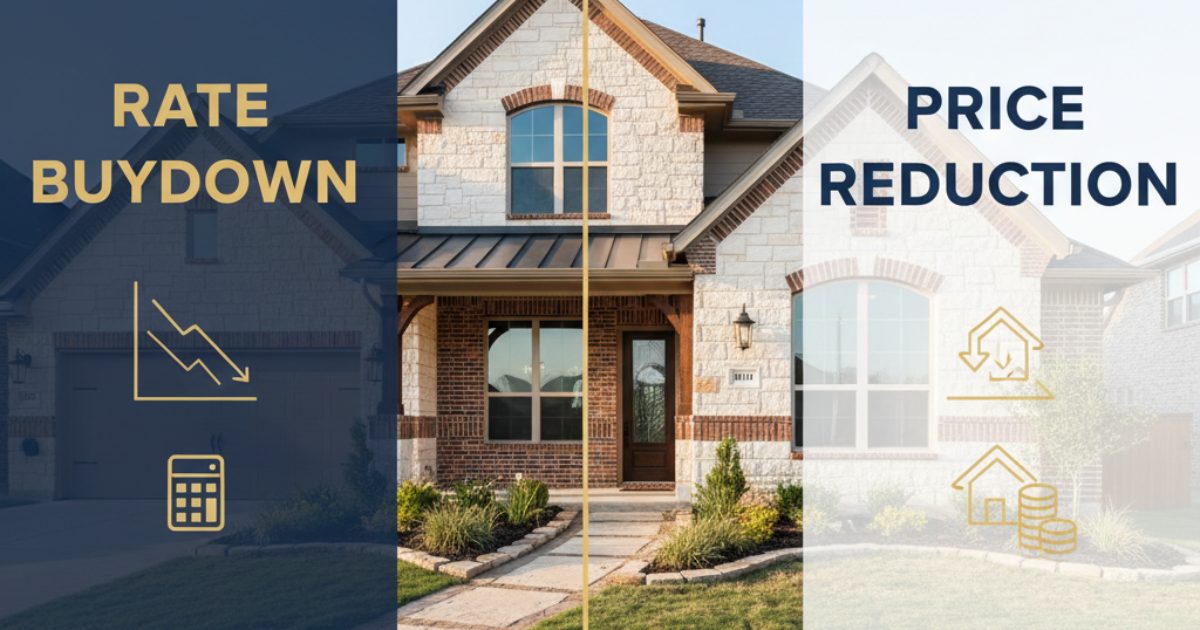
Rate Buydowns vs. Price Cuts: A $400,000 North Texas Home Example
Let’s use a hypothetical new construction purchase to understand the difference.
Assumptions:
Original home price: $400,000
Down payment: 20%
Original loan amount: $320,000
Mortgage term: 30-year fixed
Contractual interest rate: 7.25%
Comparison: A 2-1 temporary buydown versus a $15,000 purchase-price reduction
The 7.25% rate is an illustrative assumption, not a current mortgage quote.
Scenario A: No Builder Incentive
A $320,000 mortgage at 7.25% over 30 years produces an estimated monthly principal-and-interest payment of:
$2,182.96
This is our baseline.
Scenario B: Builder-Funded 2-1 Temporary Buydown
With a hypothetical 2-1 temporary buydown:
PeriodEffective payment rateMonthly P&IYear 15.25%$1,767.05Year 26.25%$1,970.30Year 3 onward7.25%$2,182.96
Compared with the baseline payment:
Year 1 savings: Approximately $415.91 per month.
Year 2 savings: Approximately $212.67 per month.
Total payment subsidy over the first 24 months: Approximately $7,543.
The borrower still has a 7.25% contractual note rate, and the temporary subsidy must be funded under the applicable loan program.
After the second year, the scheduled principal-and-interest payment returns to the full amount.
Scenario C: $15,000 Purchase-Price Reduction
Now suppose the builder reduces the purchase price to $385,000.
With 20% down:
New down payment: $77,000
New mortgage amount: $308,000
Interest rate: 7.25%
Estimated monthly principal and interest: $2,101.10
That is approximately $81.86 less per month than the original mortgage.
If the mortgage remains outstanding for the full 30-year term, the lower loan amount results in approximately $29,470 less in total principal-and-interest payments.
That figure includes the $12,000 reduction in the initial amount borrowed; it is not entirely interest savings. The buyer also puts $3,000 less down initially.
So Which Incentive Wins?
The temporary buydown provides substantially more monthly payment relief during the first two years.
The purchase-price reduction lowers the original mortgage principal and provides smaller monthly savings throughout the loan.
But this illustration does not establish which offer is financially superior.
Why?
Because we haven’t specified the builder’s actual cost to fund the temporary buydown, whether an equivalent credit could be applied to the purchase price, or how long the buyer expects to keep the mortgage.
For a fair comparison, buyers should ask the builder and lender to price both alternatives using the same incentive budget.
Then compare cash needed at closing, total payments, outstanding mortgage balance, and financing costs over the expected ownership period.
The best deal is the one that fits your actual financial circumstances—not necessarily the one with the lowest advertised payment.
Why Might Builders Prefer Mortgage Rate Buydowns?
Builders may have business reasons for offering financing incentives rather than reducing prices.
For example, a builder might want to:
Preserve advertised prices within a subdivision.
Avoid creating lower comparable sales that could influence future appraisals.
Make monthly payments more attractive to prospective buyers.
Encourage buyers to purchase completed inventory.
Promote financing packages offered through preferred lending partners.
These considerations don’t mean a buydown is automatically bad for buyers.
They simply explain why an incentive may be structured differently from a price reduction.
A buyer should evaluate the full financial package rather than assuming the builder’s preferred option is the most economical.
North Texas Buyers: Don’t Forget Property Taxes, MUDs, PIDs, and HOA Fees
This is particularly important for buyers exploring new construction in Kaufman, Rockwall, Collin, and surrounding North Texas counties.
The advertised mortgage payment is only one part of homeownership.
Your actual monthly housing expenses may also include:
Property taxes
Homeowners insurance
Mortgage insurance, if applicable
HOA dues
Municipal Utility District (MUD) taxes, where applicable
Public Improvement District (PID) assessments, where applicable
MUDs and PIDs are not interchangeable. Their financing structures and obligations can differ.
Not every subdivision has these assessments, so buyers should verify the specific property rather than assume all new construction communities have the same costs.
Texas appraisal districts generally determine taxable market value as of January 1 under applicable law, rather than simply adopting a home’s contract price.
You can learn more through the Texas Comptroller’s property valuation guidance.
Before purchasing, request a detailed estimate of the property’s applicable taxes and assessments, including how future completed-home valuations may affect costs.
A home with a lower mortgage rate may still have a higher total monthly payment than another property once all expenses are considered.
For additional context, read our guide to Forney new construction versus resale homes.
Should You Use the Builder’s Preferred Mortgage Lender?
Many builders advertise incentives that depend on financing through a designated preferred lender.
That arrangement may provide legitimate benefits, but buyers should compare the full loan terms.
Ask the preferred lender and at least one independent lender for comparable written Loan Estimates.
Review:
Interest rates and APR
Origination charges and discount points
Closing costs and lender credits
Cash required at closing
Monthly principal and interest
Mortgage insurance, if applicable
Temporary versus permanent rate terms
The Consumer Financial Protection Bureau recommends comparing Loan Estimates rather than focusing exclusively on advertised interest rates.
An incentive that looks attractive initially may provide less value if another financing package has lower overall costs.
Five Questions to Ask Before Accepting a Builder Incentive
Before signing a new construction contract in North Texas, ask these five questions.
1. Is the incentive available if I use my own lender?
Find out whether financing through the builder’s preferred lender is required.
2. Is the advertised mortgage rate temporary or permanent?
Ask for the contractual note rate, payment schedule, and written financing terms.
3. Can the incentive be applied toward a price reduction or closing costs instead?
Some builders may allow alternative incentive structures, subject to their policies and financing restrictions.
4. What are the property’s total monthly ownership costs?
Include taxes, insurance, HOA dues, and applicable MUD or PID obligations.
5. What happens if I sell or refinance within a few years?
Ask your lender to compare the costs and remaining loan balances under realistic ownership timelines.
These questions can help prevent expensive surprises.
Why Having Your Own REALTOR® Matters With New Construction
One of the most common misconceptions about purchasing a newly built home is that buyers don’t need their own real estate representation.
A builder’s sales representative works for the builder.
An independent buyer’s REALTOR® can help you understand your options, evaluate comparable properties, discuss available incentives, and navigate the transaction process.
At The Cole Home Team, our goal is to help buyers make informed decisions—not simply encourage them to choose a particular home or builder.
We can assist with evaluating new construction opportunities, understanding market conditions, and coordinating with qualified lenders, inspectors, and other professionals as needed.
If you’re exploring communities around Forney, our guide to comparing new construction builders in Forney is another helpful starting point.
Before visiting a model home, ask about the builder’s registration and buyer-agent policies. Representation and compensation arrangements should be discussed and agreed upon in writing.
Frequently Asked Questions About North Texas Builder Incentives
Are builder mortgage rate buydowns really free?
Not necessarily. Although the builder may fund the incentive, its cost is part of the overall transaction economics. Buyers should compare the purchase price, financing terms, and total costs rather than assume the advertised subsidy has no tradeoffs.
Can I negotiate a lower price instead of a mortgage rate buydown?
Sometimes. Builders may be willing to negotiate purchase prices, closing-cost credits, or other incentives. Availability depends on the builder, property, market conditions, and financing restrictions.
Do I have to use the builder’s preferred lender?
Not always. However, specific advertised incentives may require using the builder’s preferred financing provider. Review the offer terms and compare outside financing before making a decision.
Is new construction a good option in Forney, Texas?
New construction may be worth considering for buyers who want modern floor plans, energy-efficient features, and builder warranty coverage. However, location, taxes, financing, construction quality, and resale considerations should all factor into the decision.
Should I buy a new construction home in 2026 or wait until 2027?
There is no universal answer. Your financial readiness, available inventory, mortgage terms, personal timeline, and the specific property’s value matter more than trying to predict future interest rates or home prices.
Should I bring a REALTOR® when visiting a new construction builder?
Yes, if you want independent buyer representation. Contact your chosen REALTOR® before visiting and review the builder’s registration requirements and your representation agreement.
Before You Accept a Builder Incentive, Know What You’re Really Getting
A lower mortgage rate sounds appealing. So does a $15,000 price reduction.
But the biggest advertised incentive isn’t always the best financial decision.
Whether you’re searching for a new construction home in Forney, Rockwall, Royse City, Terrell, McKinney, Prosper, Plano, or elsewhere in North Texas, understanding the complete cost of your purchase is essential.
At The Cole Home Team, we help buyers compare their options, understand builder incentives, and make confident, informed real estate decisions.
Before you visit a builder’s sales office or sign a contract, let’s talk about what you’re looking for and how to evaluate the opportunities available to you.
Connect With The Cole Home Team
Call or Text: 469-474-9129 / 469-260-1550
Email: robert@thecolehometeam.com or mandy@thecolehometeam.com
Website: https://www.thecolehometeam.com
Thinking about buying new construction in North Texas? Contact The Cole Home Team and let’s find the right home—and the right deal for you.
Disclaimer: This article is for general educational purposes and is not mortgage, legal, or tax advice. Financing examples are hypothetical and do not represent current lender or builder offers. Rates, fees, eligibility, taxes, and incentives vary. Consult appropriately licensed professionals regarding your individual circumstances.
Frequently Asked Questions
Why are homebuilders offering incentives like rate buydowns and price cuts?
Homebuilders are offering incentives to attract qualified buyers due to affordability pressures in the new construction market. National data shows a significant percentage of builders are using sales incentives, with many also reducing home prices.
What is the difference between a temporary and a permanent mortgage rate buydown?
A temporary rate buydown lowers your mortgage payment for an initial period, typically one to three years, before reverting to the full contractual rate. A permanent rate buydown involves paying upfront costs to secure a lower fixed interest rate for the entire life of the loan.
How does a purchase price reduction differ from a rate buydown?
A purchase price reduction lowers the overall cost of the home and the initial loan amount, leading to smaller monthly payments and less total interest paid over the loan's life. A rate buydown, especially a temporary one, can offer more significant immediate monthly savings but doesn't reduce the principal loan balance.
Why might a builder prefer offering a mortgage rate buydown over a price cut?
Builders may prefer rate buydowns to maintain advertised prices within a subdivision, avoid impacting future appraisals with lower comparable sales, or make monthly payments more attractive to buyers. They might also do this to promote preferred lending partners.
Besides the mortgage payment, what other costs should I consider with North Texas new construction?
You must also account for property taxes, homeowners insurance, potential mortgage insurance, HOA dues, and specific assessments like Municipal Utility District (MUD) taxes or Public Improvement District (PID) fees. These can significantly impact your total monthly housing expenses.