
Table of Contents
- A Discount From What?
- Incentives and Equity Do Different Jobs
- Understand What the Rate Offer Actually Means
- Think About Your Future Competition
- Why an Existing Home May Be the Better Fit
- This Is Where Your REALTOR® Earns Their Keep
- Buy With the Numbers in Mind
New Construction vs Resale: Builder Savings vs Real Equity
By The Cole Home Team
Yesterday, I was talking with a client about buying new construction and how easily a builder’s advertised savings can be mistaken for instant equity.
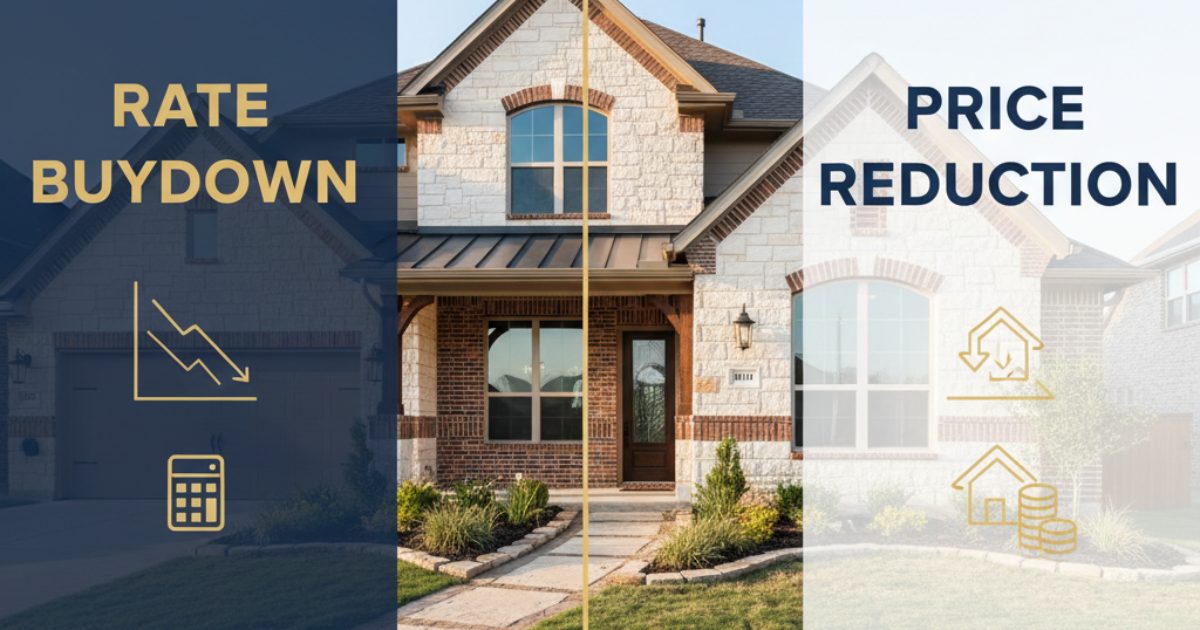
You’ve seen the offers: $30,000, $40,000, or even $50,000 off the price, plus up to $30,000 in builder incentives.
To a buyer, that can sound like walking into a home with $60,000 or $70,000 in equity before the moving truck even arrives.
Buuuuut… those numbers alone don’t establish equity.
Builder incentives can provide real financial benefits. The question is what those benefits actually do for you and whether the purchase price makes sense compared with the market.
A Discount From What?
Suppose a builder originally advertises a home for $500,000 and later reduces the price to $460,000.
That’s a $40,000 price reduction. But did the buyer gain $40,000 in equity?
The original asking price cannot answer that question. It tells us what the builder wanted to charge, not necessarily what the home is worth today.
If comparable sales support a value of $460,000, buying that home for $460,000 means paying market value. The advertised reduction doesn’t automatically create an additional $40,000 ownership stake.
The same rule applies to an existing home. A seller can reduce a listing by $50,000 and still be overpriced.
Before celebrating the discount, we need to evaluate the final price.
Incentives and Equity Do Different Jobs
A builder’s incentive package might help pay eligible closing costs, fund a mortgage rate buydown, or cover certain upgrades.
Those benefits can matter. Closing-cost assistance may preserve your cash. A favorable financing package may make the monthly payment more manageable.
But money used to pay transaction costs does not automatically increase the home’s value or reduce your mortgage principal.
Here’s a hypothetical example, assuming the full incentive is permitted and used for eligible closing costs and a rate buydown:
Item Amount Original advertised price $500,000 Actual purchase price $460,000 Builder incentive $30,000 Down payment of 10% $46,000 Starting mortgage balance $414,000 Assumed supported market value $460,000 Estimated starting equity $46,000
The promotion advertises $70,000 in combined discounts and incentives. The buyer’s estimated equity in this example is $46,000, reflecting the down payment.
The calculation is straightforward:
Current market value − mortgage debt = equity.
If the supported market value were higher or lower, the equity calculation would change. That value has to come from market evidence, not the promotional flyer. And equity is different from the money you would keep after selling expenses.
Understand What the Rate Offer Actually Means
A temporary buydown typically uses an upfront subsidy to reduce your initial out-of-pocket mortgage payments. It does not change the interest rate stated in the mortgage note. When the subsidy ends, you become responsible for the full scheduled payment.
A permanent rate buydown uses points to obtain a lower contractual interest rate. That benefit continues while you keep that loan.
Either arrangement may be useful. Before choosing one, compare the builder’s preferred lender with outside lenders. Review the rate, fees, cash needed at closing, and payment after any temporary subsidy expires.
The lowest introductory payment does not tell the whole financial story.
Think About Your Future Competition
If you need to sell while the builder is still constructing homes nearby, your resale may compete with brand-new homes offering incentives, warranties, and choices of finishes.
That doesn’t guarantee a loss. It does deserve consideration before you buy, especially if your ownership timeline could be short.
A future buyer will compare your home with the available alternatives. They won’t determine its value by adding up the discounts you received when you purchased it.
Why an Existing Home May Be the Better Fit
For buyers, an established home can offer advantages that deserve just as much attention as a builder’s incentive package.
You can evaluate the neighborhood as it exists today: its surroundings, landscaping, traffic patterns, and proximity to the places you use regularly.
Depending on the property and seller’s circumstances, your REALTOR® may also be able to negotiate the purchase price, repairs, eligible closing-cost assistance, or possession timing. Resale sellers can sometimes contribute toward financing costs or buydowns, too, subject to loan requirements and the agreement.
There are tradeoffs. An existing home may need a roof, HVAC replacement, or other updates. Those expenses belong in the comparison.
New construction offers new components and may include warranty protection, but coverage varies. Buyers should review the actual terms, exclusions, and responsibilities rather than assume every issue will be covered.
The better purchase depends on the entire property and transaction not simply whether the home is new.
This Is Where Your REALTOR® Earns Their Keep
Before making an offer, buyers need more than the asking price and a quick price-per-square-foot calculation.
A REALTOR® can prepare a comparative market analysis using relevant sales within an appropriate area and time period. Useful comparisons consider:
Location and neighborhood characteristics.
Size, layout, age, and condition.
Lot size, improvements, and features.
Sale dates and changing market conditions.
Known seller concessions and transaction terms.
There isn’t one radius or timeframe that fits every home. A subdivision property and a rural acreage home may require very different searches.
Concessions also require judgment. Fannie Mae’s December 2023 Appraiser Update explains that appraisers should analyze how concessions affect comparable sale prices. That does not mean automatically subtracting every incentive dollar for dollar.
A REALTOR®’s market analysis helps guide the offer and negotiations. A lender’s appraisal provides a separate opinion of value for the financing process. Neither guarantees future appreciation.
The goal is to give you evidence you can use before committing your money.
Buy With the Numbers in Mind
New construction can be an excellent purchase. So can an existing home.
Before deciding, compare the supported price, financing terms, cash required, condition, ongoing expenses, and likely ownership timeline.
An existing home may offer the location and negotiating opportunities you want. A new home may offer features and financing benefits that suit your needs better.
What matters is understanding exactly what you’re getting.
An advertised discount is a starting point for questions. It is not proof of equity.
If you’re considering buying in North Texas, let’s compare your options, examine the relevant sales, and negotiate with a clear understanding of the numbers.
The Cole Home Team
469-474-9129
robert@thecolehometeam.com
www.thecolehometeam.com
Sources Referenced
- Is there such a thing as a no-cost or no-closing-cost loan or refinancing? (www.consumerfinance.gov)
- fanniemae.com (singlefamily.fanniemae.com)
Frequently Asked Questions
What is the difference between builder discounts and actual home equity?
Builder discounts, such as price reductions or incentives, are not the same as equity. Equity is the difference between your home's market value and your mortgage debt. A discount only reduces the purchase price, it doesn't automatically increase the home's value beyond what comparable sales support.
How do builder incentives affect my home purchase?
Builder incentives can help pay for eligible closing costs or fund a mortgage rate buydown. While these benefits can reduce your upfront cash needs or make monthly payments more manageable, they do not directly increase the home's value or reduce your mortgage principal.
What should I consider about a builder’s mortgage rate offer?
You should compare the builder's preferred lender with outside lenders, looking at the rate, fees, and cash needed at closing. Understand if the offer is a temporary buydown, which only lowers initial payments, or a permanent buydown that lowers the contractual interest rate.
What are the risks of buying new construction if I might sell soon?
If you need to sell your new construction home while the builder is still active nearby, your property might compete with new homes offering incentives and warranties. Future buyers will assess your home's value based on current market conditions, not the discounts you received at purchase.
When might an existing home be a better choice than new construction?
An established home allows you to evaluate the neighborhood's current state, including traffic and proximity to amenities. Additionally, a seller of an existing home may be more open to negotiating on price, repairs, or closing costs compared to a builder.